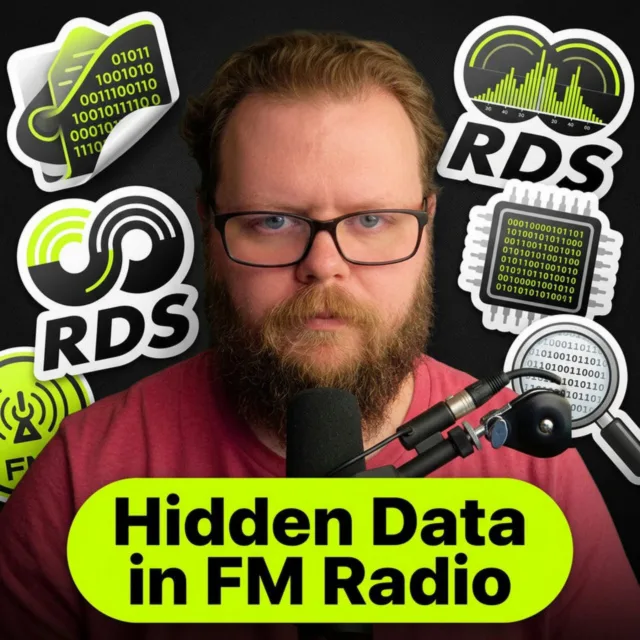
EP 25: WHAT IS RDS? THE DATA HIDING IN FM RADIO
DESCRIPTION
There's a tiny data protocol still riding inside FM signals after all these years, and it's the reason your car's dashboard knows what song is playing. RDS and its US cousin RBDS are quietly holding up more than most people realize.
I cover where the standard came from, how it actually works at the technical level, and why it still matters for modern radio and modern vehicles.
TRANSCRIPT — EP 25
Every FM radio station in the country has a little data stream hidden inside it. It's been there for decades. Most listeners don't know it exists. And I mean, why would you? A lot of radio stations forget it's even running or how to set it up properly. It's called RDS and it's the reason your car knows what's playing and can show it on your dash. And in parts of Europe, it'll actually interrupt your music to tell you that there's a wreck on the highway. This is the Tyler Woodward Project. I'm Tyler. Everything in this episode is from my point of view, and any opinions are my own. Today I'm talking about RDS and RBDS, where it came from, how it ended up in the United States, and why a 1984 data protocol is still
holding up the metadata backbone of FM radio in the US in 2026. RDS stands for Radio Data System. RBDS is the Americanized version. Same tech, slightly different implementation because we like to be different. The data rate is about 1 .2 kilobits per second. A single second of Spotify audio carries roughly 13 ,000 times more data than an RDS stream can send in a full second. This isn't a fire hose of data, it's more like a drip from a leaky faucet. And it's outlasted
a dozen or so systems that were supposed to replace it. The German predecessor to RDS was called ARI, and it did exactly one thing. In the late 1960s, German broadcasters wanted car radios to alert drivers when there was a traffic alert erring. Not play it, not switch to it, not display it. Just light up a little indicator on the dash. Yes or no. That was it. The European Broadcasting Union figured there was probably more you could do with that idea. They started a working group back in 1974. Ten years of field trials and competing proposals and the final spec was released in
1984. Commercial RDS car radio showed up at the Berlin radio show in 1987. Volvo shipped the first factory -installed RDS unit that same year. The U .S. didn't have a standard until 1993, when the National Radio Systems Committee published the NRSC -4. That's the RBDS spec. Several revisions followed, and in 2021, the standalone American standard was retired. and folded back into the international IEC standard as a named variant. Now, we can't talk about RDS and RBDS without
getting a tad bit technical, so strap in, because here we go. FM radio signals have a certain structure to them that most people never think about or would ever care to think about, unless you're like me and you work in the industry or you're just a nerd. Either way, this stuff is fascinating. FM stereo broadcast carries a 19kHz pilot tone above the left plus right summed audio. Your radio uses that as a reference clock. From that, the receiver decodes a 38kHz subcarrier carrying the stereo difference signal, also called left minus right, which is the information that separates
the left audio channel from the right audio channel, if that wasn't clear from the left minus right. RDS sits at 57 kHz, three times the pilot tone, and that's not a coincidence. Locking RDS to the third harmonic of the pilot means it shares the same reference clock as everything else in the signal. A receiver already decoding a stereo signal has everything it needs to decode RDS. In the 1980s, that meant adding RDS to a car radio was cheap. The groundwork was already there. The 1 .2 kilobit data rate isn't a random number
either. It comes straight from the math of the signal itself. Everything is locked together. the pilot tone, the subcarrier, the bit clock, one big synchronized system. Whoever designed this was smart. Way smarter than me, I'll give you that. Now, one question I get about RDS is, well, why doesn't AM have this? Well, there's no room. FM modulation gives you enough bandwidth to stack subcarriers above the audio without interference. That's how stereo works. That's how RDS works. AM is a 10 kilohertz wide channel.
Think of it like Wi -Fi channels. 20 megahertz, 40 megahertz, 80 megahertz, but much, much smaller. The audio, the carrier, everything has to sit in that 10 kilohertz. There's nowhere to hide a subcarrier without landing on your own audio channel or worse, a neighboring station. The NRSC actually had a placeholder for AMRDS and the early versions, but even with trials there was never a deployment because of physics. You can't fit it in there if there isn't room for it. This is why HD radio matters more so for
AM stations than FM, at least on the metadata side alone. The digital sidebands carry song title, artist information, album art, station names, and station logos. For stations that converted, it works and looks absolutely amazing. For the majority of AM stations that haven't, Well, your dashboard shows a frequency and not much else. 1040 AM. In 2026, that's just not good enough anymore. The data stream is organized into groups of 104 bits with error correction built right in. The first 16 bits of every group, every time
is the program identification code, the pie. In the US, it's calculated from the call sign. Feed a receiver the Pi, and it can decode the call sign. Group Type 0 carries the program service name, the eight -character station name on your infotainment system. Eight characters. Because that's what could fit on a mid -1980s car radio screen. The limit was designed around hardware that... hasn't existed for 40 some odd years and it hasn't changed. Group type 2 is radio text up to a whopping 64 characters song title
and artist. An extension called radio text plus adds position tags so the receiver knows which characters are the song title and which is the artist. That's what builds the now playing display in the song history. that shows up on modern head units. There are also groups for clock sync alternate frequencies so a car radio can follow a station across various transmitters as you drive. Traffic announcements and the data only traffic service called TMC that fed European navigation devices for about 15 years before Google Maps made that irrelevant. Most American
stations don't use a lot of the features that are available. Typical small to mid -market FM stations typically put their call letters in the 8 -character PS field, a static radio text that says something like, thanks for listening to 93 .3 The Rock or whatever station. A genre code that was probably configured by whoever set up the encoder years ago. or whatever defaults shipped from the factory. There's a station out by where I'm at that continues to say undefined, and it's been that way for 10 plus years, it's probably not gonna get fixed. The RBDS encoder can be a standalone box, usually at the transmitter
site, but it can also be placed at the studio and sent by a lot of different methods out to the transmitter site. like Micro -MPX. Sometimes RBDS encoders can be built into the transmitter themselves and processors like the Omnia 9. There's Inovonix out of Santa Cruz. They make the most common RBDS encoders in the US radio market. And there's WorldCast that handles European installs, major markets over there. There's a Czech company called Pura that's become sort of a cult item and low power in college radio stations. I've seen engineers recommending that specifically because it's so cheap, you can sort of treat
it as disposable. You can usually find those for about one hundred and ninety to five hundred bucks. We had a couple of these at the last cluster I worked at and they just worked and they were simple little boxes to set up. Not much to them. Now, that said, the standalone encoder It's slowly becoming a thing of the past. Nontel exciters now have RDS built directly into the web interface. You log into the transmitter and you configure it right there. No separate box. There's Orban that just announced at NAB 2026 that the new Optimod 5950 has Q's visual radio platform baked directly into the audio processor itself. The
whole chain. Audio processing, RDS encoding, metadata management collapsed into one box. Great news for small stations who don't want to manage various pieces of gear, but less great news if you're in the business of selling standalone encoders. When the automation to encoder chain is maintained, it works fine and it looks great. When it's ignored you get stations with the wrong format code set for years and While speaking of that there's a documented case of an engineer taking over a station after an ownership change and finding The encoder was still broadcasting
the previous formats branding the format had ended nine years earlier nine years of wrong data Now how nobody noticed? I find that hard to believe, but it seems to have happened, at least from a post over on radio discussions about it. The 8 character scrolling thing has its own argument. The European standard says PS is a static name. Period. Full stop. The American RBDS standard allows changes if they're not too distracting. What did American radio hear? You
can change it! And it immediately started running full slogans through the field eight characters at a time like a marquee sign. European automakers hate this. There's a radio world piece specifically about a new Audi putting the scrolling PS text right next to the speedometer in the driver's sightline. Don't be that station. Don't do that. Now parts of RDS and RBDS are aging out. The TMC traffic service over in Europe is shutting down. The eight character display limit is embarrassing at this point, but we got to talk about the Pi code because it's still doing something that nothing else can do. It's literally holding up
the next generation of metadata in the radio. Xperi. The company behind HD radio runs a system called DTS Auto Stage. It's in over 16 million vehicles across 13 brands including BMW, Ford, Audi and Mercedes. It reads the pie code off the RDS stream, uses that as a lookup key against a cloud database and pulls down a high -res version of the station's logo, album art, and full metadata that the subcarrier itself could never carry in that one point something kilobit stream. The broadcast sends a 16 -bit identifier. The internet
sends everything else. The bridge is a number from a 1984 standard. Only thing about this, it does rely on cellular data to support it. Radio DNS does the same thing from a different approach. It takes the Pi code, builds a DNS style query, and it gets back a URL with enriched metadata. Same Pi being used. Emergency alerting is another reason why radio hasn't fully disappeared. EAS runs on FM because FM works when cell networks fail. There are commercial alerting systems built onto the RDS subcarrier specifically to push
emergency techs during tornadoes and tsunami warnings. FEMA certified it. It's active in 17 plus states. It's called Alert FM and it's a separate platform that you can have run alongside your station. Switzerland tried to prove FM was done in obsolete. They shut off the National Public FM Network at the end of 2024 and lost 25 % of the German -speaking audience almost immediately. By late last year, parliament reversed it. RDS is a foundation of radio, at least FM radio, that nobody thinks about. It runs quietly,
and it's been running quietly for 40 -something years. And the industry mostly ignores it until something breaks. The Pi code is a good example of how these things go. Designed to let a receiver verify it had the right station before switching frequencies. Now it's the identifier connecting a broadcast signal to a cloud database of logos and album art. in over 16 million cars. It became load -bearing without anyone planning for it to become load -bearing. 40 years, about 1 .2
kilobits per second, still doing its thing. If this made you want to see what your local FM station is sending, grab an SDR app that decodes RDS and pointed at your favorite radio station. It's a rabbit hole. I'm not going to be responsible for wherever that leads you. RDSpy is a free tool you can grab on GitHub if you want to go down that hole. Thanks for listening to the Tyler Woodward Project. This is an independently produced and written podcast by myself. And if you would like to support the project, head over to tylerwoodward .me slash subscribe and become a member today. It goes a long way and it makes me feel all. warm and fuzzy inside. You can also follow me
on blueskythreads and instagram at tylerwoodward .me. I'll catch you guys next week.